
There’s a very specific kind of tired that comes from being your own worst critic. Not physically tired, more like emotionally worn down, the way you feel after arguing with someone all day, except the person you’ve been arguing with is you.
If you’re here because you’re tired of that voice and you typed some version of “how to stop being hard on yourself” into a search bar at 11 pm, I want you to know two things first: 1) You’re not broken and 2) you are definitely not the only one quietly working through this, me included.
There have been many times when I’ve compared myself to other creators or bloggers. It got to the point where I got so much in my own head that I talked myself out of creating. I developed self-doubt from a spark of creativity, and it created these invisible barriers where I boxed myself in instead of allowing myself to soar. I think about the wasted time and action I could have taken, but that’s why I’m on a journey of quieting that voice of self-critic and judgement. I know this example probably resonates with so many others out there, and that’s why it’s important to talk about why we self-sabotage in the first place and how we can reframe our inner critic.
Table of Contents
Why We’re So Hard on Ourselves in the First Place
It’s funny because I’m sure you don’t intend to be your own worst critic, it just sort of happened… It built up slowly, maybe it was learned, or you developed comparison to keep up in a world that treats rest like something you have to earn. Somewhere along the way, being hard on yourself started to feel like the same thing as having high standards. Like if you eased up even a little, you’d stop trying altogether.
But here’s the thing I keep coming back to. Self-criticism isn’t actually motivation. It just wears the same outfit. Psychologists who study this describe it as an internal commentator that nitpicks everything you do, and over time that constant nitpicking doesn’t push you toward more, it just wears you down. Most of the time, it’s not even about the actual mistake. It’s about a much older belief that says you have to earn love, safety, or approval by getting everything right.
The Signs You’re Being Too Hard on Yourself (Even If It Feels Normal)
Some of this is so normalized that it doesn’t even register as harsh anymore. See if any of this sounds familiar:
- You apologize for things that were never your fault, or weren’t even a big deal
- You replay a conversation from three days ago and cringe at one sentence you said
- You call yourself lazy or behind on a day you were actually just tired
- You hold yourself to a standard you’d never once hold a friend to
- You feel like rest has to be earned instead of just needed
- One mistake feels like proof of a bigger flaw, not just a mistake
If you nodded along to more than one of those, that’s not a character flaw. It’s just a pattern, and patterns can shift.
How to Stop Being So Hard on Yourself, One Practice at a Time
I want to be honest with you before we get into this part. There’s no single trick that makes the inner critic disappear for good, and I’d be lying if I told you there was. What actually works is smaller and slower than that. It’s a handful of practices you come back to, over and over, until being gentler with yourself starts to feel more familiar than being harsh.
Catch the Voice Before You Believe It
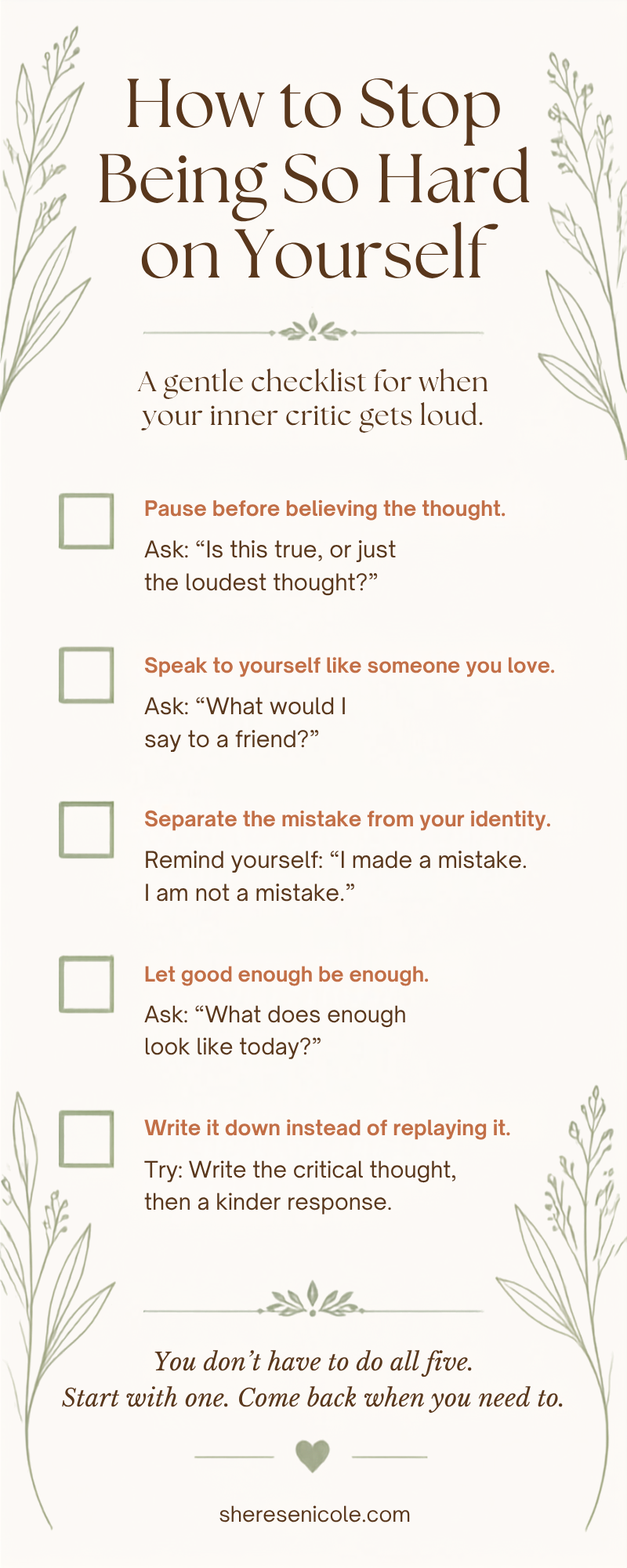
The goal isn’t to silence the critical voice, it’s to notice it before you automatically agree with it. When you catch yourself thinking something like “I always mess this up,” pause and ask if that’s actually true, or if it’s just the loudest thought in the room. One approach clinicians recommend is neutralizing the thought rather than forcing it into something falsely positive, taking it from “I always mess this up” to something closer to “that didn’t go how I wanted, and that’s allowed to happen.” It’s a small shift, but it’s the same shift behind practicing positive self talk, which is less about forced positivity and more about interrupting the autopilot.
Talk to Yourself the Way You’d Talk to Someone You Love
This is the practice I come back to the most, honestly. Before you respond to yourself, ask what you’d say to a friend who told you the exact same thing about herself. You’d probably remind her she’s human. You’d probably tell her one bad day doesn’t undo everything else she’s built. Try saying that to yourself, even if it feels a little awkward at first.
This isn’t just a nice idea, it’s actually backed by a fair amount of research. Self-compassion researchers describe it as three things working together: being warm with yourself instead of critical, remembering that struggling is something every single person deals with, and staying present with a hard moment instead of spiraling into it or shutting it out entirely. People who practice this consistently report less anxiety and stress over time, which tracks, because it’s hard to feel calm when part of you is constantly on trial.

Separate What You Did From Who You Are
“I made a mistake” and “I am a mistake” are two completely different sentences, but the inner critic loves to blur them together. When something goes wrong, try to name the actual, specific thing that happened instead of the sweeping story your brain wants to tell about it. You missed a deadline. You didn’t miss it because you’re incapable, unreliable, or somehow behind everyone else.
This is also where harsh self-talk and self-sabotage tend to show up together. When the voice in your head keeps telling you you’re not good enough, it gets a lot easier to quietly stop trying, because why put in effort for someone you’ve already decided is going to fail.
Let “Good Enough” Actually Be Enough
Perfectionism will tell you that easing up on yourself means you’ll stop caring about anything. In my experience it’s the opposite. Chasing perfect all the time is exhausting, and exhaustion is not the same thing as excellence. Ask yourself what “good enough” would actually look like for this one thing, today, and let that be the finish line instead of some invisible standard you never agreed to out loud.
Write It Down Instead of Replaying It on a Loop
Getting the thought out of your head and onto paper does something that just thinking about it over and over doesn’t. It gives you a little distance from it. You start to notice the pattern instead of just living inside it. If you’re new to it, keeping a simple journaling habit can be as easy as writing down what your inner critic said today, and then writing what you’d say back to it if you were talking to someone you loved.
When the Inner Critic Comes Back Anyway
It will come back. I say that not to discourage you, but because I don’t want you to think you’ve failed at this the first time you catch yourself spiraling again. This isn’t a switch you flip once, it’s a muscle you keep building, the same way it takes practice to eat with self trust instead of guilt, or to rest without feeling like you have to earn it first.
Give yourself permission to be a beginner at this, because most of us are. The goal was never to never hear the critical voice again. It’s to stop treating it like it’s automatically telling you the truth.
One Last Thing
If there’s one thing I want you to take from this, it’s that being gentler with yourself isn’t self-indulgent, it’s necessary. You’ve been carrying a version of yourself that speaks to you the way you’d never let anyone else speak to you. You’re allowed to put that down.
I’d love to hear from you. What does your inner critic usually say, and what’s one thing that’s helped you talk back to it?